
Federal Releases Serving Hodgeman
The Federal Bureau of Prisons operates a national correctional system separate from the Hodgeman County Sheriff and Kansas Department of Corrections. The research found no BOP institution in Hodgeman County. A local connection can still exist through a federal prosecution, a transfer by the sheriff, or a person returning to Hodgeman County after serving a sentence elsewhere.
A BOP release ends the federal prison custody shown by the Bureau. Many federal sentences are followed by supervised release imposed by the federal court. Supervised release is a court-controlled period after imprisonment, not continued BOP confinement and not the same as Kansas parole or probation. The federal judgment and later docket entries are the sources for its length, conditions, changes, or termination.
| Federal record | What it can establish | What it cannot establish alone |
|---|---|---|
| BOP “Released” result | A BOP custody release and displayed date | End of court supervision |
| “Not in BOP custody” | The person is not shown in current BOP custody | Freedom from every custodian |
| Federal judgment | Sentence and supervised-release term | Exact later physical exit without BOP data |
| USMS information | Pretrial or transport context when available | A public nationwide inmate history |
BOP Released Inmate Search
The BOP Inmate Locator is the first public search for someone who served a federal prison sentence. Search by a federal identifier when one is known. Name and demographic fields can also locate a record, but same-name results require careful comparison. Locator coverage generally includes many former federal inmates in records from 1982 onward.
- Choose the identifier search if a BOP register, DCDC, FBI, or INS number is available. Otherwise use the name search and offered demographic fields.
- Compare the complete returned identity. Do not rely on a name alone.
- Read the custody label exactly. If it says “Released,” record the displayed date and the date the search was run.
- Find the matching federal judgment or docket to check the sentence and any supervised-release term.
- If the result is absent or unclear, determine whether the person is instead with USMS, a state or local jail, or ICE.
The BOP’s official explanation of locator coverage and custody labels was captured for the facility research from its records information page:
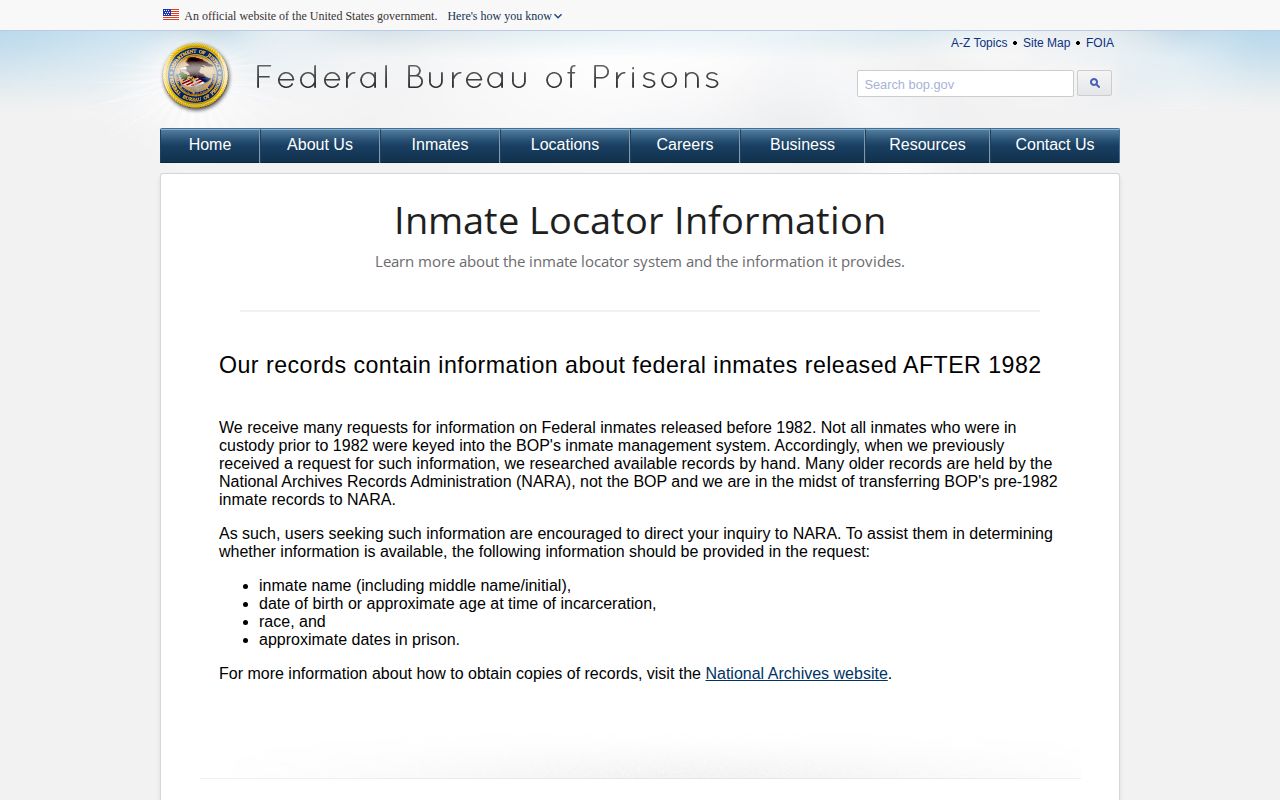
The source helps frame the result correctly. The locator is a BOP record, so a label about BOP custody should not be expanded into a claim about all federal, state, local, or immigration custody.
When BOP Custody Is Absent
“Not in BOP custody” is a warning to identify the custodian, not a universal release label. A person may be in U.S. Marshals Service pretrial custody, housed under an arrangement at a local or state facility, present on a court writ, recently moved, held by ICE, outside public locator coverage, or affected by a data delay. The lack of a current BOP placement does not resolve those possibilities.
The USMS manages many federal pretrial detainees and movements but does not provide a general public locator equivalent to BOP’s. For a pretrial person, use the federal docket, the clerk, counsel, or the responsible USMS office as appropriate. PACER is the federal court docket system. Docket entries may show detention, release conditions, judgment, revocation, or later supervision action, but a court entry is not always the exact physical transfer time.
If Hodgeman County Jail handed a person to a federal authority, obtain the county release transaction first. The official Hodgeman County directory supplies the sheriff contact route. The local transaction may show that county custody ended and name a destination when public. Then begin a second timeline under the federal custodian. The Hodgeman County released-inmate lookup explains why one handoff can generate distinct county and federal records.
Federal Prison Release Records
A locator result is a useful public lead, not a certified release instrument. For a record needed in a court or legal process, identify the exact document and its custodian. The BOP owns its inmate record. The federal court owns the judgment and docket. USMS owns its own detention or transport records. Each agency can apply federal disclosure rules to its material.
A focused inquiry should provide the full name, federal register number, date of birth, case number, sentencing court, and the exact event being checked. Ask for an existing release record or clarification of a displayed custody label. Do not ask an office to produce a new research summary. A result may be redacted or withheld where federal law protects information. If a Hodgeman state case intersects with the federal custody event, use the Kansas district-court records route for that separate state filing.
Federal Bureau of Prisons
Nationwide federal correctional system
Public route: BOP Inmate Locator
No BOP institution identified in Hodgeman County
Use the live BOP contact route for records questions
There is no verified local BOP address or release desk to list. A facility address depends on the person’s actual federal placement. Find that placement from the record before contacting an institution, and verify current contact details on the official BOP site.
Federal Release and Supervision
Federal supervised release follows imprisonment in many cases. It is imposed by the court and administered through the federal probation system. The BOP locator’s release date does not show that the supervised-release term ended. Check the judgment for the ordered term and the docket for later modification, revocation, early termination, or discharge.
Revocation can return a person to confinement. A new federal, state, local, or immigration detainer can also affect where the person goes when BOP custody ends. The final destination should be confirmed from current agency information rather than inferred from the original sentence or a planned release date.
A planned BOP date may also differ from the day a person reaches a home, program, or supervision address. Movement to a residential reentry setting, another lawful custodian, or transport status can change the practical location without ending every federal obligation. The locator’s exact wording controls. When a destination affects a pending legal matter or a planned meeting, verify it through the responsible federal office and the current court record instead of projecting from an old sentence summary.
- BOP release
- The end of the prison custody event shown by the Bureau.
- Supervised release
- Court-ordered federal supervision after imprisonment.
- Detainer
- A request or notice tied to another authority that can affect the next custody step.
- Final discharge
- The end of the relevant sentence or supervision obligation.
Federal, State, or ICE Release
Choose the locator by custodian. BOP handles sentenced federal prison records. KASPER handles current and former Kansas state offenders. Kansas VINE covers county-jail custody and does not cover KDOC prisons. ICE’s locator addresses current civil immigration detention. A Hodgeman sheriff transaction can point toward one of those systems but cannot replace its record.
For a clean custody history, record four facts for each handoff: the agency that ended custody, the time it ended, the stated type of event, and the next custodian when known. Then verify the receiving event separately. This avoids turning “not in BOP custody” or “released by the county” into a broader statement than the source supports.
Note: Federal supervised release, Kansas postrelease supervision, and county probation are separate legal structures even when all occur outside a jail or prison.