
Hodgeman Projected Versus Actual Release
A projected date is a calculation based on a sentence, applicable law, credits, and current record. An actual release is the completed custody event. The two can differ. Court corrections, recalculated jail credit, disciplinary action, earned program credit, sentence aggregation, detainers, appeals, or a return after violation can move the estimate or change how release occurs.
A pretrial detainee usually has no fixed projected release date. The next event may depend on bond, a court order, dismissal, plea, sentence, or transfer. For someone held only by the Hodgeman County Jail, ask the sheriff about current custody and check the district court case. Do not apply a KDOC formula to an unsentenced jail stay. Likewise, a bond amount or upcoming hearing date is not a projected sentence-release date. It describes a different stage of the case.
Find a Hodgeman KDOC Date
Use KASPER when a Hodgeman County case resulted in commitment to the Kansas Department of Corrections. It covers current and former members of the KDOC adult supervised population, not every county-jail booking.
- Search KASPER by name or KDOC number. A known KDOC number is the strongest search key.
- Match identity using the sentencing county, offense and case details, identifiers, and other public fields.
- Read the full detail record, including status, facility or supervision location, sentence rows, and date labels.
- Copy the exact date-field name and value. Do not relabel it as a promised release date.
- Record the access date because computations and public displays can change.
- Request an official KDOC sentence-computation explanation when the date will be used in a legal process.
KASPER may not show one universal future-date field on every record. If no projected or tentative date appears, do not calculate one and attribute it to KDOC. The sentencing journal entry supplies the judicial sentence; KDOC supplies the executive calculation.
Build Hodgeman Sentence Inputs
Begin with the sentencing journal entry. Identify offense dates, severity level, prison term, whether sentences run concurrently or consecutively, jail credit, postrelease term, and the controlling sentence. The offense date matters because Kansas statutes have changed.
| Input | Why it affects the date |
|---|---|
| Offense and sentence dates | They help identify the governing version of Kansas law. |
| Term of imprisonment | The court’s base prison term begins the computation. |
| Concurrent or consecutive structure | Multiple sentences may overlap or aggregate. |
| Jail credit | Qualifying prior confinement credited by the court can reduce time remaining. |
| Good-time or program credit | Eligible credits may affect covered sentences, subject to law and KDOC calculation. |
| Postrelease term | It follows prison in many cases and is not part of physical confinement. |
| Detainer or other case | Another authority may take custody even when the KDOC prison term reaches a release point. |
Do not rebuild the date from a news story or third-party profile. Ask for an official explanation tied to the KDOC number and case when the public screen is unclear.
No Universal Kansas 85 Percent
Kansas law does not support a sitewide promise that every prisoner serves 85 percent of a sentence. The common shorthand reflects a possible 15-percent good-time ceiling for certain covered determinate sentences. Other severity levels, sentence dates, and statutory categories may use different credit ceilings. Older indeterminate sentences involve parole or conditional-release rules, and some offenses have special or mandatory provisions.
K.S.A. 21-6821 and related sentencing provisions govern credits for covered guidelines sentences. K.S.A. 22-3717 addresses parole, conditional release, and postrelease for relevant categories. The version in effect for the offense and sentence must be checked. A statutory maximum credit is not the same as credit actually earned and retained.
Why Hodgeman Release Dates Move
A projected date is a current calculation. The following events can alter the value or the form of release.
| Change | Possible effect |
|---|---|
| Court correction or appeal | Changes the sentence or controlling judgment used by KDOC. |
| Jail-credit adjustment | Adds or removes qualifying prior confinement from the calculation. |
| Disciplinary credit action | Withheld, lost, or restored credit can move a covered date. |
| Program credit | An eligible award may affect the computation under applicable law. |
| Sentence aggregation | Concurrent and consecutive terms can change the controlling release framework. |
| Detainer or hold | May send the person to another custodian rather than into the community. |
| Violation and return | A return to custody can trigger a new computation or later date. |
| Board action | For a parole-eligible case, a decision and effective date can matter, but a hearing alone does not authorize release. |
Keep different events under different labels. A parole-eligibility date is the earliest date for a process under applicable law, not a guaranteed exit. A maximum date is not interchangeable with a projected release. Discharge may occur after release from prison and a term of supervision.
Hodgeman Jail Dates Use Court Records
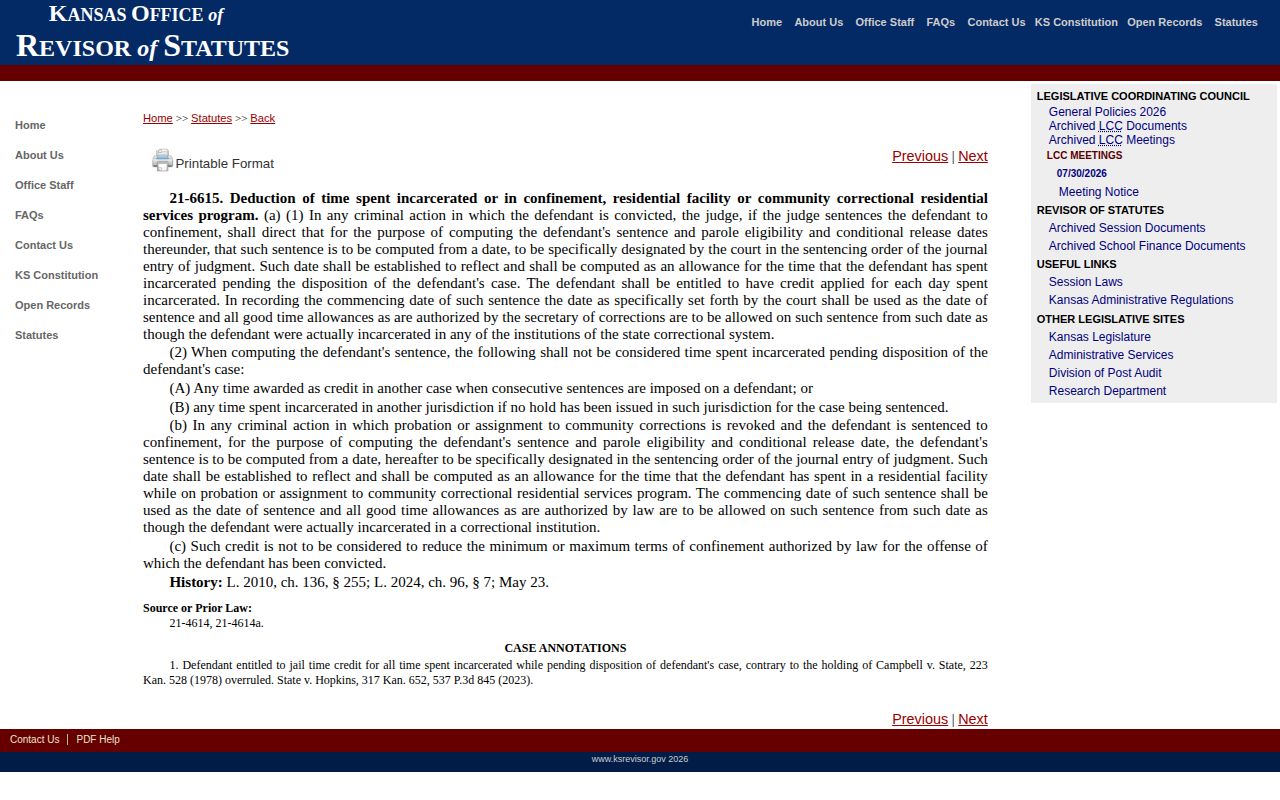
County-jail sentences are separate from KDOC prison computations. The sentencing court sets the jail term and awards qualifying confinement credit. The sheriff administers the local sentence subject to law and any valid local policy. K.S.A. 21-6615 is the route for Kansas jail credit, but the journal entry and actual sheriff transaction remain person-specific.
No official Hodgeman County jail good-time, weekend-release, holiday-release, or early-release policy was located. That gap must remain visible. Do not borrow KDOC’s credit formula or another county’s local practice. Ask the sheriff whether a written policy exists and ask the court for the sentencing and jail-credit orders.
The official jail-credit statute supports the legal navigation shown below.
No Hodgeman Local Credit Policy
The absence of a verified local policy is the distinctive rule for a Hodgeman jail calculation. The sentencing journal entry, jail-credit order, and sheriff’s actual release transaction are the defensible sources. A caller can ask whether releases are processed continuously under court orders, whether weekends differ, and whether a written county-sentence credit policy exists, but no answer should be assumed.
The sheriff owns the local custody transaction. The court owns the judgment and credit order. KDOC owns the state-prison computation. Sending the same question to the wrong office can produce an incomplete answer because each custodian controls only its own record.
- Jail credit
- Qualifying prior confinement credited toward a sentence under the court’s order and applicable law.
- Good time
- A credit concept for eligible sentences, subject to the governing rules and official calculation.
- Detainer
- A request or legal basis for another authority to take or retain custody.
- Projected date
- An estimate based on current information, not a guarantee of physical release.
Hodgeman Parole Dates Need Context
The Kansas Prisoner Review Board page is the starting point for schedules and actions in parole-eligible cases. A schedule entry only shows that a board process is planned. A favorable board action may still require an effective date, approved release plan, program completion, detainer resolution, or other conditions.
Match the board action to KASPER and the Hodgeman sentencing case. Many Kansas guidelines determinate sentences do not use discretionary parole in the same manner as older indeterminate sentences. Do not treat a hearing date, eligibility date, grant date, and physical release date as one event.
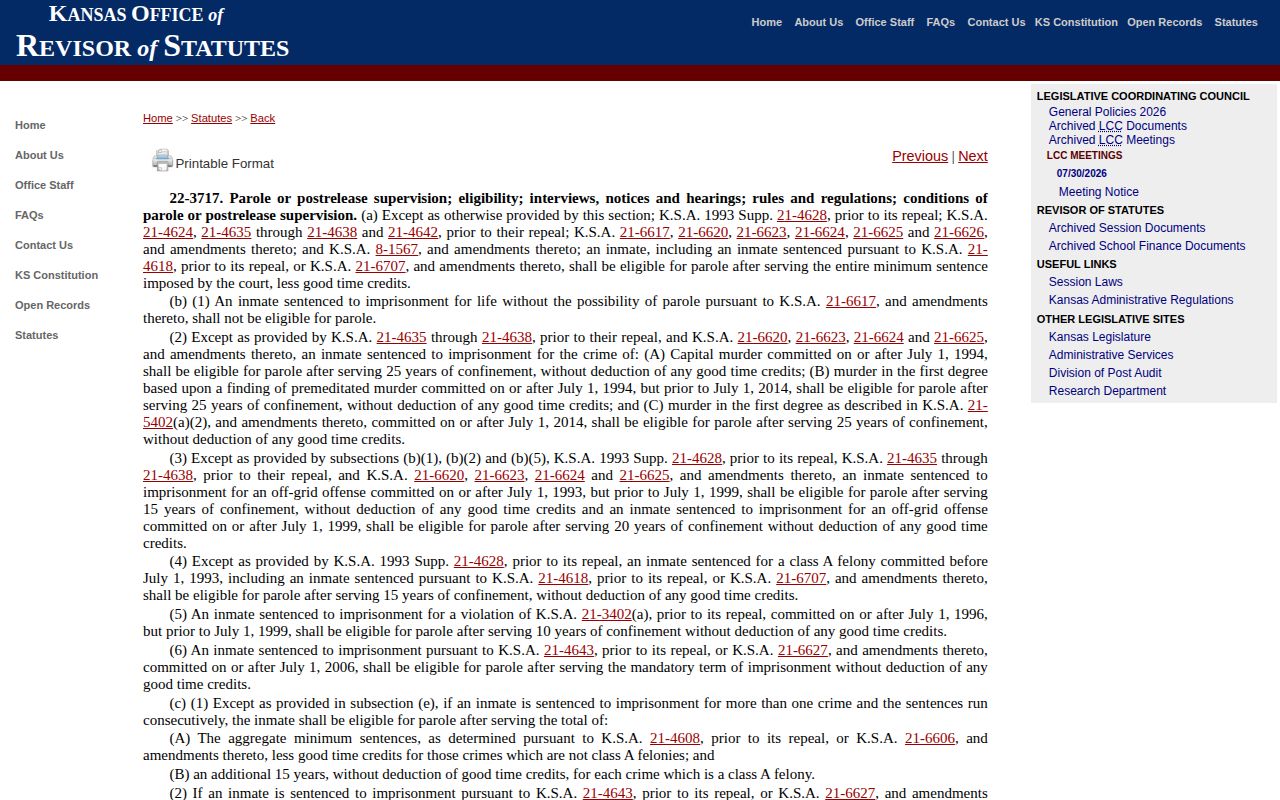
The K.S.A. 22-3717 parole and postrelease provisions are represented in the official source image below.
Confirm a Hodgeman Release Date
For a KDOC person, preserve the KASPER record and ask KDOC records or sentence computation for official clarification. Include the KDOC number, case, exact public label, and the question. For a local jail sentence, contact the Hodgeman County Sheriff at 620-357-8391 and request the court’s sentencing and jail-credit orders from the district court clerk at 620-357-6522.
Kansas VINE can provide a future county-jail custody-change notification, but it excludes KDOC state-prison offenders. A VINE alert is not an official projected date. Use the VINELink Check only for the county-jail path and verify an alert with the sheriff. Check again after any change.
A state transfer belongs with Kansas Department of Corrections facilities. Federal sentencing belongs with Federal Bureau of Prisons facilities and the federal judgment. A documented immigration transfer belongs with the ICE detention system. The local starting point remains Hodgeman County Jail.